



Apartment Air Quality: What Nobody Tells You About Your First Place
The air in your first apartment is almost always more polluted than the air outside, often by two to five times. That gap comes from a mix of new furniture, building materials, cleaning products, cooking, and the simple fact that small spaces trap everything that gets released into them. Most renters never think about apartment air quality, which is exactly why it becomes a problem.
You'll get plenty of advice about lease terms, security deposits, and which IKEA dresser is worth assembling. Nobody hands you a guide to what you're actually breathing in there. So here it is.
Your Apartment Is A Sealed Container For Everything You Bring Into It
Apartments are designed for energy efficiency, which is great for your power bill and tricky for your air. Tight seals around windows and doors keep heated and cooled air inside. They also keep everything else inside. Cooking fumes, cleaning sprays, dust, pet dander, candle fragrance, and the chemicals slowly releasing from your furniture all stay put.
Health Canada reports that indoor air can contain two to five times more pollutants than outdoor air, and in some cases up to 100 times more. For an apartment with limited cross-ventilation, the higher end of that range is closer than people think.
The New Furniture Smell Is Not A Good Sign
That fresh, slightly chemical smell from your new mattress, pressed-wood desk, or area rug has a name. It's off-gassing caused by volatile organic compounds (VOCs) being released into the air. Common sources include:
- Particleboard and MDF furniture (the glue contains formaldehyde)
- New mattresses, especially memory foam
- Synthetic carpets and area rugs
- Vinyl flooring and shower curtains
- Fresh paint and finishes
- Pressed-wood cabinets
VOCs can off-gas for weeks to months after you bring something home. The "new" smell fades long before the emissions actually stop.
Your Kitchen Is The Loudest Polluter In The Apartment
Cooking releases more airborne particles than almost anything else you'll do at home. Searing meat, frying eggs, toasting bread, and even boiling pasta water all release fine particulate matter (PM2.5) into the air. Gas stoves add nitrogen dioxide on top of that.
A studio or one-bedroom layout means those particles travel everywhere within seconds. The sectional you're sitting on, the bedding two rooms over, and the air you'll sleep in tonight all get a share. Range hoods help, but most apartment hoods recirculate rather than vent outside, which means they filter some grease and send the rest back into the room.
Does Living in an Older Apartment Affect Air Quality?
If your apartment was built before 2000, the building itself is a contributor. Older HVAC systems collect dust, pollen, and allergens in their ductwork and recirculate them. Older insulation and wall materials can release particles into the air over time. Carpets that have been in place across multiple tenants hold years of accumulated dust, dander, and dust mites.
You can't replace the building. You can control what happens in your unit.
What's Actually Floating Around In There
The mix changes based on your habits and your building, but most first apartments contain some combination of:
- Fine particulate matter from cooking, candles, and outdoor air seeping in
- VOCs from furniture, paint, and household products
- Dust mites, especially in carpeted units and older mattresses
- Pet dander, even if you don't have a pet (it travels in on clothing and through shared ventilation)
- Pollen tracked in from outside
- Mold spores in bathrooms and near windows with condensation
- Fragrance compounds from cleaning products, plug-ins, and laundry detergent
How To Tell If Your Air Quality Is Bad
Your body usually notices before you do. Common signs include:
- Waking up with a stuffy nose or dry throat
- Headaches that ease when you leave the apartment
- Worsening allergy symptoms indoors versus outdoors
- Visible dust is accumulating quickly on surfaces
- Lingering cooking smells hours after you cook
- A musty or stale smell when you come home
If two or more of these sound familiar, your apartment air quality isn’t where it needs to be.
How to Improve Your Apartment Air Quality
Some fixes are free, and some require an upgrade. The ones that move the needle most:
- Open your windows: Even ten minutes a day of cross-ventilation flushes out a meaningful amount of accumulated pollutants. Morning hours typically have the lowest outdoor pollen and pollution counts.
- Cook with the hood on, every time: Even a recirculating hood pulls some particles out of your breathing zone. Turn it on before you start and leave it running for a few minutes after.
- Skip plug-in fragrances and synthetic candles: They mask air quality issues by adding more compounds into the air. If you want scent, opt for beeswax or soy candles with cotton wicks.
- Wash bedding weekly in hot water: This is the single most effective way to control dust mites in a small space.
- Run an air purifier: An air purifier with a true HEPA filter (99.999% efficient at capturing airborne particles) handles what ventilation and habits can't. Look for a unit sized for the square footage of your space, with a clean air delivery rate that matches your room. Airmega air purifiers are built for exactly this scale of living.
Which Airmega Is Right For Your Apartment?
Apartment size determines which Airmega fits your space best. Match the unit to your square footage so it can cycle the full room volume multiple times per hour.
- For small spaces up to 96 m2: Airmega 50 or Airmega 150: compact, quiet enough for sleeping spaces, easy to move room to room.
- For medium spaces up to 173 m2: Airmega Mighty2 or Airmega 250: strong coverage for open-concept layouts where the living room and kitchen share air.
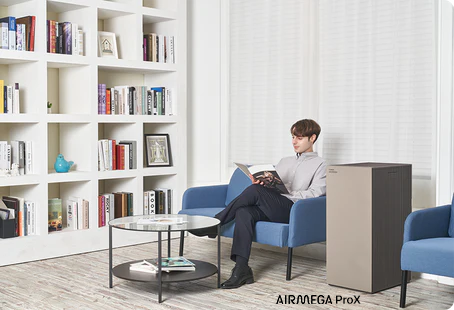
- For large spaces up to 395 m²: Airmega 400, Airmega 350, and ProX: handle bigger footprints and high-traffic cooking zones with room to spare.
Your First Apartment Should Feel Like Home, Not A Sealed Box
Apartment air quality is one of those hidden variables that shape how you feel without ever announcing itself. Better sleep, fewer allergy flares, fresher mornings, and a space that actually smells clean instead of masked all trace back to it.
Shop Airmega and breathe easier in your space.
Disclaimers
1 Airmega air purifiers have been proven to trap dust, pollen, dander in the air based on KCL(Korea Conformity Laboratories) testing. They have been tested according to the Korea Air Cleaning Association standard (SPS-KACA 002-132:2022 Modified) to measure the 0.01㎛ size of particle removal rate. It was tested on maximum airflow speed in normal room temperature and humidity conditions. The performance may vary in the actual living environment of customers. Tested with Airmega Aim, 50, 100, 150, Tower AP-1216L, Mighty AP-1512HH, MightyS AP-1512HHS, 200M, Icon, 230, 240, 250, 250S, 300, 300S, 350, 400, 400S, 450, ProX
2Our HEPA filter complies with IEST-RP-CC007 standards at speed level 1 as tested by SGS (Société Générale de Surveillance). SGS's test report only reflects SGS's evaluation of the sample and does not reflect the evaluation of the batch of goods from which the sample was taken. Tested with Airmega 100, 150, 160, Mighty AP-1512HH, MightyS AP-1512HHS, 200M, 230, 240, 250, 250S, 250 Art, 300, 300S, 350, 400, 400S, 450, ProX
3 Tested by KCL(Korea Conformity Laboratories) according to JEM 1467: 2015 condition, the concentration of acetic acid was proven to be reduced up to 99.5% in 60 minutes. Results may vary depending on actual environment. Tested with Airmega 150, Mighty AP-1512HH, 200M
4 Tested by KCL(Korea Conformity Laboratories) according to SPS-KACA002-132:2022, showed result of over 99.5% removal rate of common household gases including Ammonia, Acetaldehyde, Acetic acid, Formaldehyde, Toluene, Benzene, Nitrogen dioxide (NO₂), and Sulfur dioxide (SO₂) within 30 minutes. Results may vary in different environments and not all odors or gas particles may be removed. Tested with Airmega MightyS AP-1512HHS, 250S, 300S, 400S, 350, 450
5 Test conducted using Coway Allergen filter media (5×5 cm) placed in a polyethylene bag. The allergen solution and sample were immersed in 2 mL of phosphate buffer (100 ng/mL) prior to the reaction and heat-sealed to specimen size. The reaction was maintained at 4°C for 24 hours. Nichinichi Pharmaceutical Co., Ltd. conducted the test using ELISA to measure allergen concentration. Results may vary in actual product usage environments. Tested with Airmega Mighty AP-1512HH, 200M
6 Removal rates of Ammonia (NH₃) and Hydrogen Sulfide (H₂S) were tested in a 1 m³ chamber under EL608:2023 conditions for 30 minutes. Gas Detector Tubes were used for measurement, and testing was conducted by KCL (Korea Conformity Laboratories). Results may vary in actual product usage environments. Tested with Airmega Mighty AP-1512HH, 200M
7 Reduction rates of Naphthalene, Sulfur Dioxide, and Nitrogen Dioxide were tested using the Airmega Mighty AP-1512HH in 1㎥ chamber, following JEM-1467:2015 standards. Tests were conducted by Intertek. Actual performance may vary depending on the living environment. Tested with Airmega Mighty AP-1512HH, 200M
9 Tested by KCL(Korea Conformity Laboratories) according to SPS-KACA002-132:2022. The test was conducted with Methyl mercaptan, Isovaleraldehyde, Isovaleric acid in a 1.0±0.1 m³ chamber with a test time of 60 minutes at (24±4)°C and (46±10)% Relative Humidity. A removal ratio of over 99.5% was achieved. Results may vary depending on the actual usage environment. Tested with Airmega 350, 450
10 Tested by the Guangzhou Institute of Microbiology, exposed the filter media to protein solutions for 24 hours under ISO 4333-2022 standard. The results showed strong reduction performance: >99.79% for pollen, >99.60% for dog allergen, >99.90% for cat allergen, and >99.80% for dust mites matter allergen. Actual results may vary depending on room size, airflow, and pollutant levels. Tested with Airmega 350, 450
11 Tested by KCL(Korea Conformity Laboratories) according to SPS-KACA002-132:2022. The test was conducted in a 1.0±0.1 m³ chamber for 60 minutes at (24±4)°C and (46±10)% Relative Humidity. A removal ratio of >99.5% was achieved for Formaldehyde and Toluene in 60 minutes. Results may vary depending on the actual usage environment. Tested with Airmega 350, 450
12 Tested by Intertek. The evaluation was conducted against designated test materials: Sulfur dioxide, Nitrogen dioxide, and Naphthalene. The test was performed in a sealed 1.0×1.0×1.0 m (1.0 m³) odor chamber at a test room temperature of (23±2)°C (measured between 23.6∼23.9°C) and a test room humidity of (45±5)% R.H. (measured between 40∼48)% Relative Humidity. It met the odor removal rate of ≥99.9% for Sulfur dioxide, Nitrogen dioxide, and Naphthalene. Results may vary depending on the actual usage environment. Tested with Airmega 350, 450
* Order Acceptance and Right to Cancel: The receipt of an order confirmation does not constitute Coway’s acceptance of an order. Coway reserves the right, at its sole discretion and at any time after receiving your order, to accept, decline, or cancel your order for any reason. If Coway cancels your order after you have already been billed, we will notify you via the email address provided and issue a full refund of any billed amounts immediately.
**Shipping Policy & Restrictions: Free standard ground shipping is available only for qualifying orders shipped to standard residential and commercial addresses within the Canadian provinces. Please note that we do not ship to P.O. Boxes. We reserve the right to exclude and cancel free shipping to the Canadian Territories (Yukon, Northwest Territories, and Nunavut), as well as certain remote locations or postal codes—including remote areas within British Columbia (BC)—that qualify as remote regions under carrier guidelines. In such cases, Coway reserves the right to cancel the order and issue a full refund.



