



Coway Research and Development: creating Airmega
The people on the Coway Research and Development Team have a healthy obsession, Luckily, it’s to help people live happier, healthier lives. When it comes to purification technology, there are only a small number of dedicated research teams trying to make improvements to the air we breathe. Coway has won numerous design and engineering awards for their line of air purifiers, known as Airmega.
Everything is considered
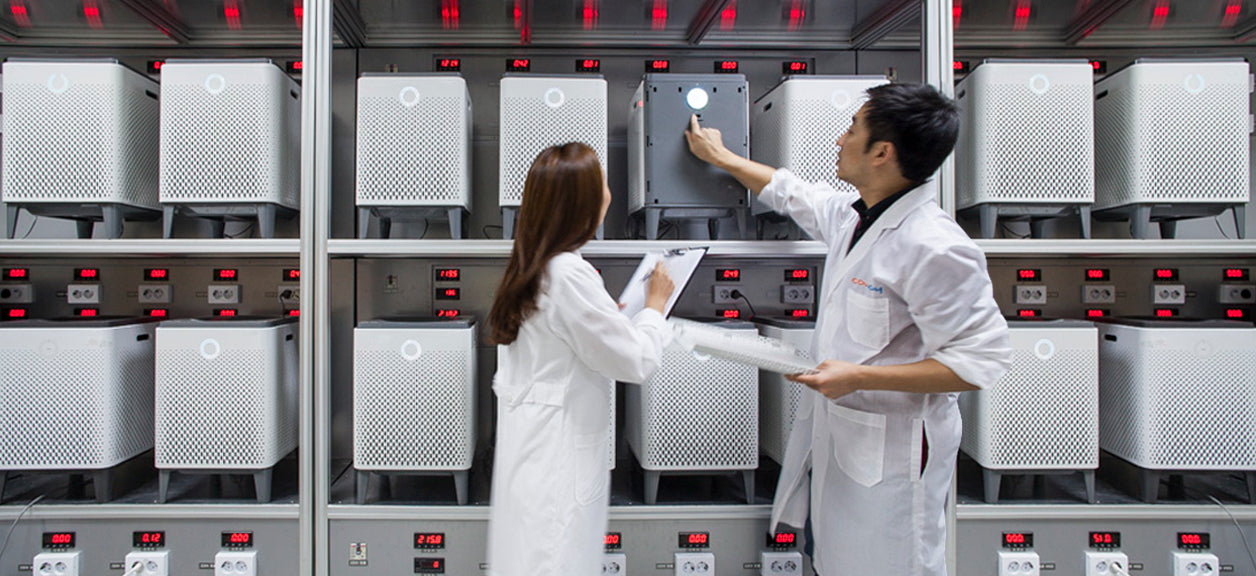
When developing a new purifier, efficiency and effectiveness is determined by much more than its size and shape. For Airmega, designers concern themselves with every measurement, including the space between the front cover and the inside. Every structure and element within the purifier can change the efficiency of the machine. That’s why Airmega undergoes extensive testing and re-testing, all in a strive for perfection. When a Coway product finally goes to the market, you’ll know it’s been through thousands of tests. Air flow, energy consumption, capture efficiency, and hundreds of other data points are collected to help the team move forward with perfecting the device.
 Senior research engineer Hyun Kuk Choi inspects the Airmega AP-1512HHs closely.
Designing smarter purifiers
More and more, purifiers are becoming technology-based, with internet and Wi-Fi capability. With the introduction of app and voice control, Wi-Fi equipped Airmegas now give you unprecedented knowledge and power to purify your air. Not only do they measure in real-time the quality of your indoor air, they can also track over time the outdoor quality, and give you detailed reports.
The quest for better is endless
Senior Research engineer Hyun Jin Hong, who has been working with the Airmega Development Team for 12 years, explains that the work is never done, because you can always do better. “Coway is a company that strives to do its best in a never ending effort to provide quality products to the consumers." He truly believes in the work they are doing to give people happier, healthier lives. “We breathe every second for 24 hours everyday to live. But the air we breathe has dust, various harmful gases, VOCs, pollen, pet hair, viruses, and other invisible particles. Air purifiers will help collect those, give us clean air and protect us from harm.”
 Hyun Kuk Choi inspects the design of a Coway Max2 Filter.
An unprecedented filtration system
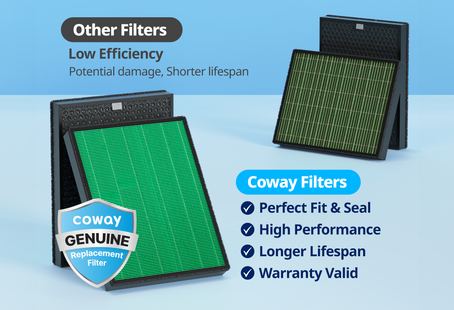
Hong describes HyperCaptive™, the network of capture technologies that truly give Airmegas an edge: “The Coway filter system removes 99.999%* of particles as small as 0.01 microns. Our Max2 filter has both the Green True HEPA™ filter and deodorization filter. Not only does the Green True HEPA™ capture the virus, but also destroys it."
It’s true. The team has developed a treatment on the surface of Coway’s Green True HEPA™ filter (H13) that remove viruses and bacteria, meaning they won’t be able to grow or populate in your environment. It’s an edge that has consumers racing to the stores for Coway’s award-winning Airmegas.
Learn more about Airmega here.
*Coway air purifiers have been proven to trap dust, pollen, dander, viruses and bacteria in the air based on KCL(Korea Conformity Laboratories) testing. They have been tested in a 30㎥ size chamber according to the Korea Air Cleaning Association standard (SPS-KACA 002-132:2018 Modified) to measure the 0.01㎛ size of particle removal rate. It was tested on maximum fan speed in normal room temperature and humidity conditions. The performance may vary in the actual living environment of customers. Tested with Coway Airmega 150, AP-1216L, AP-1512HH, AP-1512HHS, 250, 250S, 300, 300S, 400, 400S.
Disclaimers
1 Airmega air purifiers have been proven to trap dust, pollen, dander in the air based on KCL(Korea Conformity Laboratories) testing. They have been tested according to the Korea Air Cleaning Association standard (SPS-KACA 002-132:2022 Modified) to measure the 0.01㎛ size of particle removal rate. It was tested on maximum airflow speed in normal room temperature and humidity conditions. The performance may vary in the actual living environment of customers. Tested with Airmega Aim, 50, 100, 150, Tower AP-1216L, Mighty AP-1512HH, MightyS AP-1512HHS, 200M, Icon, 230, 240, 250, 250S, 300, 300S, 350, 400, 400S, 450, ProX
2Our HEPA filter complies with IEST-RP-CC007 standards at speed level 1 as tested by SGS (Société Générale de Surveillance). SGS's test report only reflects SGS's evaluation of the sample and does not reflect the evaluation of the batch of goods from which the sample was taken. Tested with Airmega 100, 150, 160, Mighty AP-1512HH, MightyS AP-1512HHS, 200M, 230, 240, 250, 250S, 250 Art, 300, 300S, 350, 400, 400S, 450, ProX
3 Tested by KCL(Korea Conformity Laboratories) according to JEM 1467: 2015 condition, the concentration of acetic acid was proven to be reduced up to 99.5% in 60 minutes. Results may vary depending on actual environment. Tested with Airmega 150, Mighty AP-1512HH, 200M
4 Tested by KCL(Korea Conformity Laboratories) according to SPS-KACA002-132:2022, showed result of over 99.5% removal rate of common household gases including Ammonia, Acetaldehyde, Acetic acid, Formaldehyde, Toluene, Benzene, Nitrogen dioxide (NO₂), and Sulfur dioxide (SO₂) within 30 minutes. Results may vary in different environments and not all odors or gas particles may be removed. Tested with Airmega MightyS AP-1512HHS, 250S, 300S, 400S, 350, 450
5 Test conducted using Coway Allergen filter media (5×5 cm) placed in a polyethylene bag. The allergen solution and sample were immersed in 2 mL of phosphate buffer (100 ng/mL) prior to the reaction and heat-sealed to specimen size. The reaction was maintained at 4°C for 24 hours. Nichinichi Pharmaceutical Co., Ltd. conducted the test using ELISA to measure allergen concentration. Results may vary in actual product usage environments. Tested with Airmega Mighty AP-1512HH, 200M
6 Removal rates of Ammonia (NH₃) and Hydrogen Sulfide (H₂S) were tested in a 1 m³ chamber under EL608:2023 conditions for 30 minutes. Gas Detector Tubes were used for measurement, and testing was conducted by KCL (Korea Conformity Laboratories). Results may vary in actual product usage environments. Tested with Airmega Mighty AP-1512HH, 200M
7 Reduction rates of Naphthalene, Sulfur Dioxide, and Nitrogen Dioxide were tested using the Airmega Mighty AP-1512HH in 1㎥ chamber, following JEM-1467:2015 standards. Tests were conducted by Intertek. Actual performance may vary depending on the living environment. Tested with Airmega Mighty AP-1512HH, 200M
9 Tested by KCL(Korea Conformity Laboratories) according to SPS-KACA002-132:2022. The test was conducted with Methyl mercaptan, Isovaleraldehyde, Isovaleric acid in a 1.0±0.1 m³ chamber with a test time of 60 minutes at (24±4)°C and (46±10)% Relative Humidity. A removal ratio of over 99.5% was achieved. Results may vary depending on the actual usage environment. Tested with Airmega 350, 450
10 Tested by the Guangzhou Institute of Microbiology, exposed the filter media to protein solutions for 24 hours under ISO 4333-2022 standard. The results showed strong reduction performance: >99.79% for pollen, >99.60% for dog allergen, >99.90% for cat allergen, and >99.80% for dust mites matter allergen. Actual results may vary depending on room size, airflow, and pollutant levels. Tested with Airmega 350, 450
11 Tested by KCL(Korea Conformity Laboratories) according to SPS-KACA002-132:2022. The test was conducted in a 1.0±0.1 m³ chamber for 60 minutes at (24±4)°C and (46±10)% Relative Humidity. A removal ratio of >99.5% was achieved for Formaldehyde and Toluene in 60 minutes. Results may vary depending on the actual usage environment. Tested with Airmega 350, 450
12 Tested by Intertek. The evaluation was conducted against designated test materials: Sulfur dioxide, Nitrogen dioxide, and Naphthalene. The test was performed in a sealed 1.0×1.0×1.0 m (1.0 m³) odor chamber at a test room temperature of (23±2)°C (measured between 23.6∼23.9°C) and a test room humidity of (45±5)% R.H. (measured between 40∼48)% Relative Humidity. It met the odor removal rate of ≥99.9% for Sulfur dioxide, Nitrogen dioxide, and Naphthalene. Results may vary depending on the actual usage environment. Tested with Airmega 350, 450
* Order Acceptance and Right to Cancel: The receipt of an order confirmation does not constitute Coway’s acceptance of an order. Coway reserves the right, at its sole discretion and at any time after receiving your order, to accept, decline, or cancel your order for any reason. If Coway cancels your order after you have already been billed, we will notify you via the email address provided and issue a full refund of any billed amounts immediately.
**Shipping Policy & Restrictions: Free standard ground shipping is available only for qualifying orders shipped to standard residential and commercial addresses within the Canadian provinces. Please note that we do not ship to P.O. Boxes. We reserve the right to exclude and cancel free shipping to the Canadian Territories (Yukon, Northwest Territories, and Nunavut), as well as certain remote locations or postal codes—including remote areas within British Columbia (BC)—that qualify as remote regions under carrier guidelines. In such cases, Coway reserves the right to cancel the order and issue a full refund.



