







Design Q&A: An air purifier worth showing off
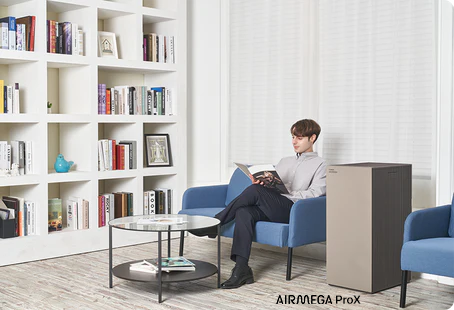
Given the drab history of air purifiers, it’s no wonder those who have them would prefer to shove the unsightly appliances into corners, keeping them out of sight as much as possible. But, what good is a purifier going to do crammed behind an end table or shoved under a desk?
Airmega Creative Design Director Ilsoo Yeom has worked for over a year to bring the humble purifier into the light. Here, he explains what it takes to deliver cleaner air from a beautiful package.
What most sets Airmega apart from other purifiers?
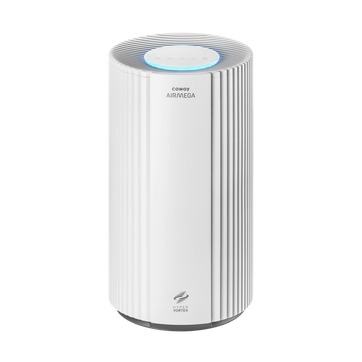
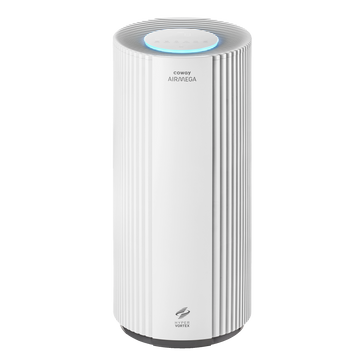
Many air purifiers are electronic- or clinical-looking products, and, because of that, they disrupt the living environment they are placed in. So we focused on creating a product that performs well but that also integrates into the home, allowing health-conscious users to place this device in their home without feeling they have to hide it.
What inspired Airmega’s design?
We were most inspired by architecture’s harmony with the environment. We looked at buildings that allow air, light, and people to circulate and co-exist—all while expressing dynamic aesthetic ideas and enhancing their location. We want the product to be a lifestyle product harmonious with its surroundings, not stand in stark contrast.
Part of that is making the purifier smaller. What allows Airmega to be as compact as it is?
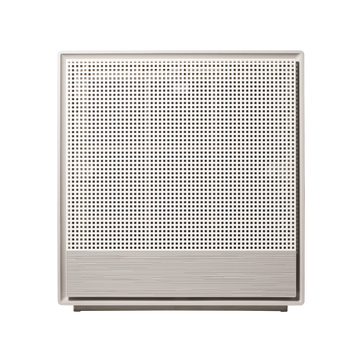
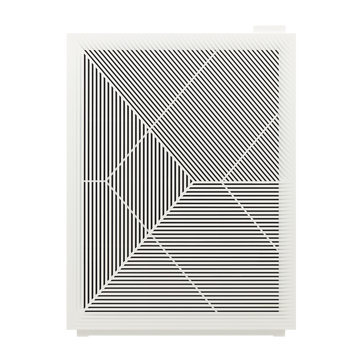
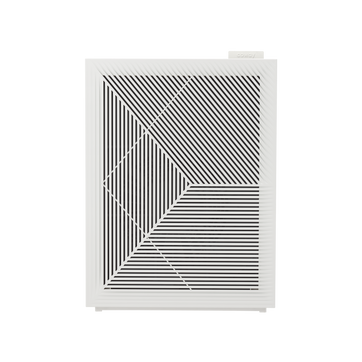
To build the most-compact air purifier (at least, compared to the similar performing competitors) we used our dual-fan system, which pulls in the air from both sides. We worked through several soft mockups with various proportions and performed tests with our engineers to find the most efficient and pleasing package. Also, the size and pattern of the holes on the outer grills were tweaked and tested several times to have the most efficient air intake area.
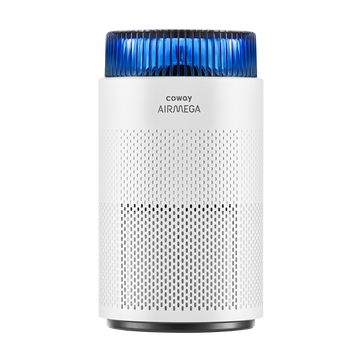
Those holes create a kind of fade as you move upward on the purifier. Why is that?
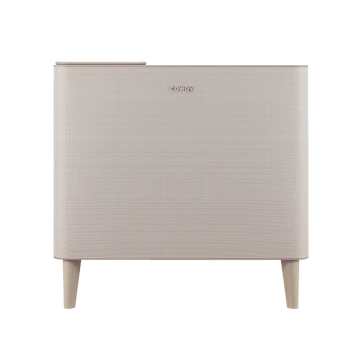
One of the concepts of Airmega was having a permeable outer skin that communicates airflow by having a pattern that dissolves as it moves up vertically. We want the pattern to reflect that the air is pulled from the sides and cleaned as it ascends upwards. The spacing of this outer layer and the legs are key to maintaining the “lightness” of the design, as well as give the feeling that air can enter the device from any direction.

Despite all this movement and power, how does the Airmega remain so quiet?
Noise from an air purifier is mostly made by the fan and the air outlet. For example, if the air outlet is small, airflow can create noise as it escapes. And, of course, if the fan speed is high there will be a lot of noise from the fan itself. Therefore, the best way to reduce the noise is to have a large air outlet and low fan speed. Reducing the fan speed, however, typically drops the product’s performance. Airmega’s dual-fan system and the hole patterns help it intake air more efficiently at slower fan speeds and, as a result, reduce the overall noise from the air purifier.
Does the upward-facing air outlet play into that, as well?
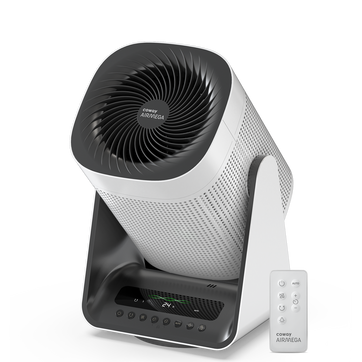
There are air purifiers that push clean air from the front, sides, or from the top. For us we have adopted a system that pushes the clean air from the top because of it is more efficient in circulating the air in a room. For instance, if the clean air pushes out from the top it will hit the ceiling and then slide along the wall and that air will go back towards the air purifier, a constant looping effect from and to the purifier.
Learn more about how Airmega is changing the way we breathe, and stay up to date on the latest news by signing up for our newsletter.
Disclaimers
1 Airmega air purifiers have been proven to trap dust, pollen, dander in the air based on KCL(Korea Conformity Laboratories) testing. They have been tested according to the Korea Air Cleaning Association standard (SPS-KACA 002-132:2022 Modified) to measure the 0.01㎛ size of particle removal rate. It was tested on maximum airflow speed in normal room temperature and humidity conditions. The performance may vary in the actual living environment of customers. Tested with Airmega Aim, 50, 100, 150, Tower AP-1216L, Mighty AP-1512HH, MightyS AP-1512HHS, 200M, Icon, 230, 240, 250, 250S, 300, 300S, 350, 400, 400S, 450, ProX
2Our HEPA filter complies with IEST-RP-CC007 standards at speed level 1 as tested by SGS (Société Générale de Surveillance). SGS's test report only reflects SGS's evaluation of the sample and does not reflect the evaluation of the batch of goods from which the sample was taken. Tested with Airmega 100, 150, 160, Mighty AP-1512HH, MightyS AP-1512HHS, 200M, 230, 240, 250, 250S, 250 Art, 300, 300S, 350, 400, 400S, 450, ProX
3 Tested by KCL(Korea Conformity Laboratories) according to JEM 1467: 2015 condition, the concentration of acetic acid was proven to be reduced up to 99.5% in 60 minutes. Results may vary depending on actual environment. Tested with Airmega 150, Mighty AP-1512HH, 200M
4 Tested by KCL(Korea Conformity Laboratories) according to SPS-KACA002-132:2022, showed result of over 99.5% removal rate of common household gases including Ammonia, Acetaldehyde, Acetic acid, Formaldehyde, Toluene, Benzene, Nitrogen dioxide (NO₂), and Sulfur dioxide (SO₂) within 30 minutes. Results may vary in different environments and not all odors or gas particles may be removed. Tested with Airmega MightyS AP-1512HHS, 250S, 300S, 400S, 350, 450
5 Test conducted using Coway Allergen filter media (5×5 cm) placed in a polyethylene bag. The allergen solution and sample were immersed in 2 mL of phosphate buffer (100 ng/mL) prior to the reaction and heat-sealed to specimen size. The reaction was maintained at 4°C for 24 hours. Nichinichi Pharmaceutical Co., Ltd. conducted the test using ELISA to measure allergen concentration. Results may vary in actual product usage environments. Tested with Airmega Mighty AP-1512HH, 200M
6 Removal rates of Ammonia (NH₃) and Hydrogen Sulfide (H₂S) were tested in a 1 m³ chamber under EL608:2023 conditions for 30 minutes. Gas Detector Tubes were used for measurement, and testing was conducted by KCL (Korea Conformity Laboratories). Results may vary in actual product usage environments. Tested with Airmega Mighty AP-1512HH, 200M
7 Reduction rates of Naphthalene, Sulfur Dioxide, and Nitrogen Dioxide were tested using the Airmega Mighty AP-1512HH in 1㎥ chamber, following JEM-1467:2015 standards. Tests were conducted by Intertek. Actual performance may vary depending on the living environment. Tested with Airmega Mighty AP-1512HH, 200M
9 Tested by KCL(Korea Conformity Laboratories) according to SPS-KACA002-132:2022. The test was conducted with Methyl mercaptan, Isovaleraldehyde, Isovaleric acid in a 1.0±0.1 m³ chamber with a test time of 60 minutes at (24±4)°C and (46±10)% Relative Humidity. A removal ratio of over 99.5% was achieved. Results may vary depending on the actual usage environment. Tested with Airmega 350, 450
10 Tested by the Guangzhou Institute of Microbiology, exposed the filter media to protein solutions for 24 hours under ISO 4333-2022 standard. The results showed strong reduction performance: >99.79% for pollen, >99.60% for dog allergen, >99.90% for cat allergen, and >99.80% for dust mites matter allergen. Actual results may vary depending on room size, airflow, and pollutant levels. Tested with Airmega 350, 450
11 Tested by KCL(Korea Conformity Laboratories) according to SPS-KACA002-132:2022. The test was conducted in a 1.0±0.1 m³ chamber for 60 minutes at (24±4)°C and (46±10)% Relative Humidity. A removal ratio of >99.5% was achieved for Formaldehyde and Toluene in 60 minutes. Results may vary depending on the actual usage environment. Tested with Airmega 350, 450
12 Tested by Intertek. The evaluation was conducted against designated test materials: Sulfur dioxide, Nitrogen dioxide, and Naphthalene. The test was performed in a sealed 1.0×1.0×1.0 m (1.0 m³) odor chamber at a test room temperature of (23±2)°C (measured between 23.6∼23.9°C) and a test room humidity of (45±5)% R.H. (measured between 40∼48)% Relative Humidity. It met the odor removal rate of ≥99.9% for Sulfur dioxide, Nitrogen dioxide, and Naphthalene. Results may vary depending on the actual usage environment. Tested with Airmega 350, 450
* Order Acceptance and Right to Cancel: The receipt of an order confirmation does not constitute Coway’s acceptance of an order. Coway reserves the right, at its sole discretion and at any time after receiving your order, to accept, decline, or cancel your order for any reason. If Coway cancels your order after you have already been billed, we will notify you via the email address provided and issue a full refund of any billed amounts immediately.
**Shipping Policy & Restrictions: Free standard ground shipping is available only for qualifying orders shipped to standard residential and commercial addresses within the Canadian provinces. Please note that we do not ship to P.O. Boxes. We reserve the right to exclude and cancel free shipping to the Canadian Territories (Yukon, Northwest Territories, and Nunavut), as well as certain remote locations or postal codes—including remote areas within British Columbia (BC)—that qualify as remote regions under carrier guidelines. In such cases, Coway reserves the right to cancel the order and issue a full refund.



